
Radiology Department
Introduction
This information leaflet aims to help answer some of the questions you may have about your peripherally inserted central catheter (PICC) line.
It will explain why you may need a PICC line, what to do before you come in for the procedure, and how to care for the line when you go home. If you have any other questions or concerns, please do not hesitate to speak to the doctor or nurse caring for you. Sometimes, a district nurse may be required to help look after your PICC line while you are at home.
What is a PICC line?
A PICC line is a long, flexible tube that is inserted into one of the veins in the arm. The length of the line depends on how tall you are and where the insertion site is. Usually, it is somewhere between 38 – 52cm long.
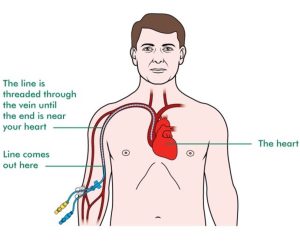
The tip of the PICC line sits in the big vein just above your heart. The other end of the PICC line comes out of the arm by about 5cm. The space inside the line is called a lumen. You may have a line with a single or double lumen. Not all patients are suitable for a PICC line, and a nurse specialist or doctor will assess your suitability before inserting the line.
Why should I have a PICC line?
A PICC line can be used to allow medication, fluids, nutrients, such as total parenteral nutrition (TPN), or antibiotics to be given intravenously (directly into a vein). It can also be used to take blood samples, which reduces the need for multiple needle punctures in the arm.
A PICC line is ideal for people with small veins or people who are scared of needles, and especially for people who need to start intensive treatment immediately or who are unable to have a different type of line because they are on blood thinning medication or are unable to lie flat. It can be used for home treatment by a district nurse. Providing the line is cared for appropriately, it can stay in place for six to eight months.
A PICC line can be used for:
What are the risks?
Like other types of central lines, the insertion of a PICC line carries a small risk of compilations. These are mentioned below. The specialist nurse or doctor will explain these risks to you.
What happens during the procedure?
The specialist nurse or doctor will first scan your arm with an ultrasound machine to look for a vein in your arm. This will help determine the right size and type of vein to place the PICC line in. Your arm will be cleaned with an antiseptic, and you will be covered with sterile drapes to ensure the area is kept clean to reduce any chances of infection.
The doctor will then inject local anaesthetic to numb the insertion site. You should not feel any pain during the procedure. However, you may feel some pressure at the insertion site where the doctor is working. The procedure usually takes approximately 20 to 30 minutes. The line will be secured with a dressing called a StatLock dressing which the line clips into. This is to ensure it is kept securely in position. X-rays will be used to confirm that the line is in the correct position.
What happens after the procedure?
Once the local anaesthetic wears off, it is quite common to feel some slight discomfort or aching in the arm where the PICC line was inserted. Most people will not require pain relief. However, if it is required, you can take your usual painkillers (make sure you follow the instructions on the label). There may also be some bruising around the insertion site and blood on the dressing. This is nothing to worry about.
In some cases, there may be some tenderness and swelling around the insertion site. This is quite common, especially during the first week following the procedure.
Make sure that you continue to move your arm normally and apply some warm pads on the insertion site as needed or until the reaction settles. However, if the pain and swelling persists, please contact the hospital and we will advise what to do next (contact numbers are at the end of this leaflet).
How will I know if there is something wrong with my PICC line?
Most PICC lines do not cause any problems. However, please contact us if you notice any of the following:
If you have any concerns, please do not hesitate to call us on the numbers provided at the end of this leaflet.
Who will look after my PICC line?
This will depend on whether you are an inpatient or outpatient. The nurses on the wards, the district nurses or a family member (who is willing to take care of the PICC line following training) will clean the insertion site and PICC line for you. They will also flush the PICC line with normal saline and change the transparent dressing. This must be done on a weekly basis.
How will I look after my PICC line when I get home?
When you get home, it is important that the transparent dressing is always kept dry. When having a bath, make sure that the insertion site and the tip of the PICC line are not sitting in the water. This will prevent your PICC line from becoming infected.
You should also avoid strenuous activities such as golf and tennis while the PICC line is in, as there is a risk that this could dislodge the PICC line or accidently pull it out.
How is the PICC line removed?
PICC lines can easily be removed. A nurse will remove the dressing and gently pull the line out. Compression will be applied for a few minutes to prevent bleeding. A small dressing is then applied over the site. There will be no pain or bleeding. The wound will heal naturally.
Please take care when washing a dressing as the wound must be kept dry whilst it is healing.
Contact us
If you have any queries or concerns about your PICC line, please contact us:
Interventional Radiology (IR) Department: 01384 456111 ext. 3124 (Monday to Friday, 8.30am – 5pm)
Oncology / haematology triage: 01384 456111 ext. 2471 (Monday to Friday, 9am – 5pm) or 01384 456111 ext. 2235 (out of hours)
You can also contact our community team:
Community IV team, Brierley Hill Health and Social Care Centre, Venture Way, Brierley Hill, DY5 1RU: 01384 321241 (7 days a week, 8am – 6pm)
If you have any questions, or if there is anything you do not understand, please contact the Russells Hall Hospital switchboard number on 01384 456111 and ask for the relevant department who issued this leaflet.
If you have any feedback on this patient information leaflet please email dgft.patient.information@nhs.net
This leaflet can be made available in large print, audio version and in other languages, please call 0800 073 0510.
Originator: Radiology Department. Review date: May 24. Next Review Date: March 26 Version: 2. DGH ref.: DGH/PIL/02133.