What is Critical Care?
Critical Care is a specialist area of the hospital where patients receive additional monitoring and support when they need closer attention.
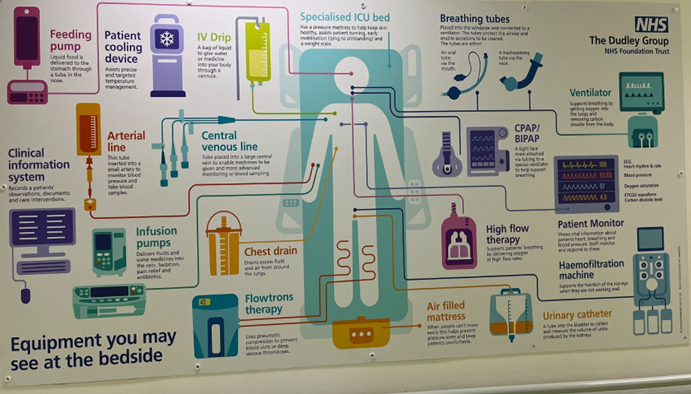
In Critical Care, a highly trained team look after patients around the clock. They use monitoring equipment to keep a close eye on things like breathing, heart rate, and blood pressure, so they can respond quickly if anything changes. These monitors can be noisy and alarm, these alarms are to alert the staff. Although we know they can be annoying they are vital for your safety and care. If noise and light is affecting your sleep/rest, please ask a member of staff for a sleep pack (eye mask and earbuds).
Why may you be admitted?
Patients may get admitted to critical care to support:
- Recovery after surgery
- Breathing support
- Heart or blood pressure monitoring
- Serious infections
- Additional support while the body recovers from illness, injury or treatment
Layout of the unit:
Here on Critical Care, we have three areas,
Area A: 9 beds – two of which are side rooms
Area B: 6 beds
Area C: 8 beds – four of which are side rooms
Side rooms are for patients who have an infection or who are at high risk of catching an infection. We understand this can be isolating but it is for the safety of patients, yourself, staff and visitors.
There are televisions in Area B and in all rooms of Area C. There are patient toilets in Areas B and C only.
Our staff work across all three areas of the unit. You may be moved from one area to another depending on your care needs.
Who will look after you?
We have a multitude of staff who may see you. These people include (to name a few):
- Consultants
- Doctors
- ACCPs (Advanced Critical Care Practitioners)
- Nurses
- CSW’s (Clinical Support Workers)
- Student Nurses
- Physiotherapists
- Dietitians
- Speech and language therapy
- Pharmacists
- Psychologists
We also use other teams of specialists when necessary.
Staff should introduce themselves and be identifiable through visible name badges. If you are unsure who someone is, please ask them.
Ward round happens every day and we have two ward rounds a day, AM and PM.
Information about visiting
Visiting is 11-8, to allow time for personal care, you to eat if able, the doctors to do their ward round and allow staff to complete medication rounds with minimal distractions to reduce error.
Visitors are asked to leave by 8pm to allow you time to rest and as this is vital to your progression and recovery. Between 1900-1930 when nurses are handing over, we ask relatives to leave the clinical area to maintain confidentiality for other patients.
Visiting can be flexible on an individual need/circumstance and should be discussed with the nurse in charge/lead nurse on duty.
Nutrition:
When you are unwell, your body needs extra energy and protein to recover, fight infection, and keep muscles working and you may experience taste changes.
We understand that it can be difficult to eat at times when you are not well, but good nutrition is important in Critical Care to help your body heal and regain strength.
If you are unable to eat well on your own, we may insert a tube called a nasogastric tube (NG) down your nose to your stomach where we can give you liquid food. You may not be able to eat normally after some surgeries, but we will keep you informed of your nutritional plan.
This is done to help you:
- Heal faster
- Maintain strength
- Support breathing and movement
- Reduce complications
If you are struggling with nutrition, please speak to a member of staff for alternative menu options.
Stepping down from Critical Care:
As you get to a level 0 (or level 1 in some cases) you will be deemed ‘wardable’ it is at this stage that we start looking for a ward bed for you. Due to hospital demands this may not happen on the same day.
You will be told which ward you are going to, and a comprehensive handover will be given to the ward staff.
You may be visited on the ward by our Critical Care Outreach Team (CCOT). One of these nurses will review your progress on the ward. When they feel you are no longer in need of these reviews they will discharge you from their list. This does not mean they will never see you again.
Ward staff and doctors can re-refer you to them and they will come and see you again if medically required. You may also be visited by the Critical Care Rehab Team if your level of care and complex needs fulfil their criteria for ongoing support.
Martha’s Rule
We want patients and families to feel heard and supported. Martha’s Rule gives you an extra way to ask for help if you are worried that your/your relatives condition is getting worse and feel your concerns have not been fully addressed. Find out more: Martha’s Rule – The Dudley Group NHS Foundation Trust