Patient Information Leaflet
Introduction
Your Speech and Language Therapist has recommended that a puréed diet may help you with your swallowing. This leaflet gives information describing the texture of puréed food, suggestions of foods you could eat and advice on how to swallow safely.
A puréed diet is made up of foods that naturally do not need chewing e.g. yoghurt or other foods that have been blended, strained or sieved to make them the right texture.
What is a puréed diet?
Puréed food is:
- Smooth throughout and has no bits, lumps or skin.
- Moist throughout.
- Able to hold its shape on a spoon or plate.
- Usually eaten with a spoon, but can be eaten with a fork because it does not fall through the prongs (see below).
- It can fall off a spoon slowly (see below).
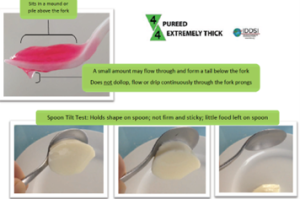
Puréed food should not:
- Require chewing.
- Have any loose liquid which has separated off or been poured e.g. milk, custard or gravy. This should either be drained off or combined within the purée.
- Be drunk from a cup or sucked through a straw.
- If you are on thickened drinks, puréed food should not be thinner than your drinks.
- If you are on thickened fluids, do not have ice cream (unless you have been told otherwise by the Speech and Language Therapy team).
Presentation suggestions:
- Presentation is important to make puréed food more appealing and appetising.
- It is a good idea to purée different types of food individually (e.g. fish, vegetables) and place them separately on the plate. This retains the individual taste and colour of the item.
- Puréed food can be piped, layered or moulded.
Preparation advice:
- Food can be puréed using a blender, liquidiser, food processor or a masher, then passed through a sieve.
- Cook food as per cooking instructions and cut into small pieces before blending.
- Puréed food often needs to be blended with a liquid/sauce to ensure it remains smooth and moist.
- If food becomes too thin, a thickener can be added to gain the correct texture e.g. cornflour or thickener.
Example foods:
Breakfast
- Puréed porridge or porridge made from powder e.g. Ready Brek.
- Weetabix made with hot milk.
- Puréed creamy scrambled egg and puréed beans.
- Puréed banana or other soft fruits.
Main meals
- Puréed meat or fish in sauce with puréed vegetables.
- Puréed casseroles or stews.
- Puréed pasta/rice with sauces e.g. lentil and vegetable curry.
- Puréed cheese and potato pie or puréed cauliflower cheese.
- Smooth, thick soups (if you are on thickened drinks, all soup should be the same consistency as your drinks).
Puddings
- Stewed puréed fruit e.g. apples, pears and custard.
- Fruit fools, smooth mousses, Angel Delight or crème caramel.
- Smooth custard.
- Puréed rice pudding.
- Yoghurts (smooth, no bits).
- No ice cream or jelly unless advised by your Speech and Language Therapist.
- Puréed banana blended and combined with cream/custard.
Safe swallowing guidelines
Strategies
- Take small sips/mouthfuls at a time.
- Make sure that after you swallow, your mouth is clear before taking the next mouthful.
- Clear any food residue from your mouth after a meal with oral care or sips of drink.
Posture
- Ensure your posture is good and sit as upright as possible.
- Ensure you remain upright for 30 minutes after eating.
Environment
- Eat in a relaxed atmosphere.
- Do not rush.
- Try not to talk while eating and drinking.
- Ensure you concentrate on swallowing.
- Meal timing may be important e.g. eating little and often.
Why is it important to follow Speech and Language Therapy advice?
Not following recommendations may place you at risk of choking or food “going down the wrong way” (aspiration). This may cause a chest infection. You can discuss this with your speech and language therapist.
Signs of swallowing difficulties
- Coughing, choking or coughing fits when swallowing food or drink (this may be during or after meals).
- A ‘gurgly’ voice after eating or drinking.
- Food remaining in your mouth after a meal.
- Shortness of breath during or after eating.
- Food getting stuck in your throat.
- Feeling chesty or having regular chest infections.
- Remember: If you are sleepy or unwell, your swallow may be worse than usual.
If you have any questions, or if there is anything you do not understand, please contact the Russells Hall Hospital switchboard number on 01384 456111 and ask for the relevant department who issued this leaflet.
If you have any feedback on this patient information leaflet please email dgft.patient.information@nhs.net
This leaflet can be made available in large print, audio version and in other languages, please call 0800 073 0510.
Originator: Helen Gough. Date originated: February 2019. Date reviewed: February 2026. Next review due: April 2029. Version: 2. DGH ref: DGH/PIL/02016.