
Trauma and Orthopaedics
Total Ankle Replacement
Patient Information Leaflet
What is a Total Ankle Replacement (TAR)?
Total Ankle Replacement (TAR) is a surgical procedure to treat advanced stage of ankle arthritis. In this operation, the bones forming the ankle joint are cut and replaced with an artificial joint (prosthesis). The ankle replacement is made up of three parts, Two metallic parts and a plastic insert between the metallic parts. The metallic parts are designed to integrate into the bones and the plastic insert gives a smooth surface for the joint to glide and rotate.
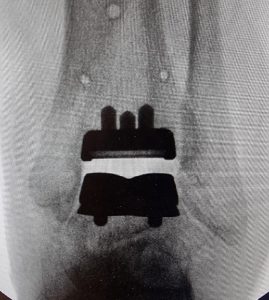
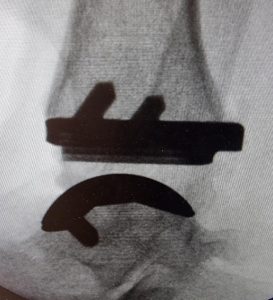
What is the aim of TAR?
The aim of TAR is to relieve pain whilst preserving ankle range of movement. TAR very successfully achieves the above goals. There is a very high satisfaction rate (Approximately 80%) amongst patients who have undergone TAR.
Who is suitable for a TAR?
TAR is indicated in patients with painful advanced ankle arthritis. There are two potential surgical options for advanced ankle arthritis, ankle fusion (joining of two bones) or TAR. The decision to proceed with TAR is made after a detailed discussion between the surgeon and the patient. Several factors are taken into consideration before offering TAR. Ankle deformity, ankle range of movement, general health of the patient, age, physical demands, condition of soft tissues around the ankle, previous fractures, body mass index (BMI) etc are taken into consideration and a shared decision between the patient and the surgeon is made before proceeding with TAR. Short to medium term results for TAR are very good. The long-term results are not known.
What happens on the day of surgery?
The patients are usually admitted on the day of the operation. On the day of the operation, the patient will see many members of the team including nurses, physiotherapists, anaesthetist, surgeons etc. The anaesthetist will discuss the type of anaesthesia with the patient. In most cases the operation is performed under general anaesthesia (patient is asleep).
Routinely, a thigh tourniquet (device to stop bleeding) is used to stop blood flow to the ankle during surgery. The ankle joint is approached through a cut made on the front of the ankle. The surgery is performed using specialist equipment and x-rays, the arthritic part of the ankle joint is removed and new joint (prosthesis) is inserted. The operation takes about 2 to 3 hours.
What is the recovery after a TAR?
The patient is placed in a plaster splint (back slab) immediately after the operation. Patients are asked not to put any weight through the operated leg for 2 to 3 weeks following surgery. As there is risk of blood clots, patients will be prescribed blood thinning injections post-operatively. Patients are brought back to clinic after 2 weeks, stiches removed and a walker boot is given, patients will progress to full weight bearing by 6 to 8 weeks. X-rays will also be done regularly to check the position of the prosthesis. Physiotherapy input may also be needed, the Doctor will discuss this with you if required
What are the complications of TAR?
- Infection/wound problems (3%)
- Blood clots/thrombosis (1%)
- Bleeding
- Swelling
- Stiffness
- Fractures (5%)
- Damage to nerve/tendon/blood vessels
- Chronic pain syndrome/unexplained pain (10%)
- Need for revision surgery (3 to 5% at 5 years)
- Loosening of implants
After surgery
Patients can expect to be in hospital for 2 to 3 days. Post surgery, patients are reviewed by a team of physiotherapists before discharge. Patients progressively improve over a twelve-month period following TAR.
- dgft.midlandsorthopaediccentre@nhs.net
- 01384 456111 Ext 4638
- dgft.vfc.dudley@nhs.net
- http://www.midlandsorthopaediccentre.co.uk/
- Please visit our YouTube channel to access some of our fracture patient information videos
- Are you following the MOC LinkedIn Page?
Originator: Mr K Jain, T&O Department. Date originated: November 2023. Date reviewed: November 2023. Next review due: August 2026. Version: 1. DGH ref.: DGH/PIL/02187