
Ophthalmology
Argon laser retinopexy (photocoagulation) for retinal tear / break
Patient Information Leaflet
Introduction
Your eye doctor has informed you that you have a retinal tear or break in the retina. This can potentially lead to retinal detachment and loss of vision.
This booklet will provide essential information to help you understand what has happened, the treatment we can offer you, and the procedures, benefits and risks of the treatment.
This booklet is not meant to replace the information discussed between you and your doctor. The information can act as a starting point for a discussion with your doctor, or as a useful reminder of the key points.
What is the retina?
The retina is the light sensitive layer at the back of the eye. The retina relays messages to the brain.
All the layers in the eye need to be in contact with each other and to the underlying layer to work properly.
What is a retinal tear?
A hole or break in the retina is called a retinal tear.
The most common cause leading to this is contraction (shrinking) of the jelly (vitreous humour) inside the back of your eye.
This causes traction (pulling) over the retina. The traction can occur in one or multiple parts, leading to a tear. It can happen in a normal eye, but is more commonly seen in people with short sightedness (myopia), advancing age and injury to the eye.
What happens if it is left untreated?
This can lead to fluid entering through the tear and going underneath the retina. This pushes the retina away from its attachment to the layer below, thus causing retinal detachment. This process can lead to loss of vision.
Laser retinopexy
The laser is a focused beam of light energy. It creates small, controlled burns around the retinal tear. This leads to scarring, which acts like a barrier and prevents the fluid from detaching the retina.
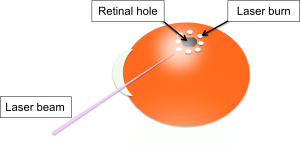
Methods of laser retinopexy
Direct laser: the laser machine is fitted onto the slit lamp (the machine used to examine your eyes when you routinely visit the Eye Clinic). The doctor will put a contact lens onto your eye. The contact lens helps to keep your eye open and enables the doctor to see the back of your eye.
This type of laser is available at Russells Hall Hospital, Dudley.
Indirect laser: in this procedure, you have to recline (lie back) on a chair or bed. The doctor will wear a special device on their head that sends the laser treatment. If required, a speculum (instrument) will be placed on your eye to keep the eye lid open. The doctor may also use an instrument to gently press on the eye. This instrument helps the doctor to see the tear in the retina.
This type of laser is available at Birmingham and Midland Eye Centre.
What are the alternative treatments?
Cryotherapy: if the retinal tear is difficult to see, it cannot be completely surrounded by the laser. In cryotherapy, a small amount of anaesthetic will be injected. Then, a freezing probe is applied on the outside of the eye. The freezing technique produces the same scarring effect around the hole as the laser treatment.
This treatment is available at Birmingham and Midland Eye Centre.
What are the possible side effects?
You need to know the possible side effects of the treatment:
- Very occasionally, a mild to sharp pricking pain can occur, this is usually for a very brief period of time.
- Spots in your vision.
- Redness of the eye following the procedure. This usually settles down in a day or two.
- Bleeding is rare and occurs for a short period of time.
- Rarely, accidental laser spots can be made to the centre of the eye.
- Occasionally, the laser treatment will not be enough to prevent a retinal detachment. If this happens, you will need retinal surgery.
Follow up
You will be reviewed in the Eye Clinic two to four weeks after the laser treatment to check that it has worked.
What happens when I go home?
Laser retinopexy reduces the risk of retinal detachment in most people. However, you must seek help straight away if you experience any of the following:
- New or increased floaters.
- Flashing lights in your eye.
- A decrease in your vision.
- A curtain or shadow appearing in the vision.
Any of these symptoms can mean a continued retinal tear or retinal detachment.
If you experience any of these symptoms, please use the information below to contact us.
What if I have any problems or questions after reading this leaflet?
Please contact the Urgent Referral Clinic team at Russells Hall Hospital Eye Clinic on 01384 456111 ext. 3633 (9am to 4.30pm, Monday to Friday).
Eye emergency, out of hours
In case of an eye emergency after the closing hours of the Eye Clinic at Russells Hall Hospital (including weekends and bank holidays), please contact:
Birmingham and Midland Eye Centre on 0121 507 4440
The doctor on call is usually based at the Eye Centre, City Hospital, Dudley Road, Birmingham. They may need to call you back, and if necessary, they will arrange for you to visit them.
Note: the information in this booklet is provided for information only. The information found is not a substitute for professional medical advice or care by a qualified doctor or other healthcare professional. Always check with your doctor if you have any concerns about your condition or treatment. This is only indicative and general information for the procedure. Individual experiences may vary and all the points may not apply to all patients at all times. Please discuss your individual circumstances with your eye doctor.
Authors: Mr A Wajid / Mr S Shafquat
If you have any questions, or if there is anything you do not understand, please contact the Russells Hall Hospital switchboard number on 01384 456111 and ask for the relevant department who issued this leaflet.
If you have any feedback on this patient information leaflet please email dgft.patient.information@nhs.net
This leaflet can be made available in large print, audio version and in other languages, please call 0800 073 0510.
Argon Laser Retinopexy /AW/SS/ST/09 2024/v4 – review 06 2027 – DGH ref: DGH/PIL/02121