
Ophthalmology
Argon macular laser treatment
Patient Information Leaflet
Introduction
The eye doctor has found that your diabetic eye disease (retinopathy) has now progressed to a stage where there has been some ‘water logging’ in the centre of your retina. The medical name for the centre of the retina is macula (see figure 1). This will reduce your central vision (eyesight) which is used for reading and other near work.
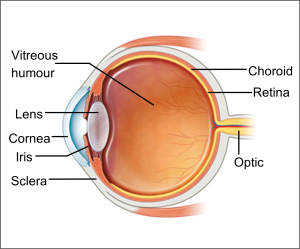
Your eye doctor has already given you a patient information booklet about diabetic eye disease and its treatment. This leaflet contains detailed information on a treatment with the medical name argon macular laser treatment. It includes information on the procedure, and its benefits and risks.
What is argon macular laser treatment?
A laser is a focused beam of light energy of a specific wavelength. It is applied as spots on the back of your eye. The treatment stops fluid leaking from the blood vessels at the back of the eye.
What are the benefits?
The treatment will help lower the risk of you losing your eyesight. It is particularly useful in cases where the circulation to the central area of the retina is damaged, or where there is scarring on the retina.
What are the risks?
- Laser treatment may cause your central vision to become worse. This is usually temporary and rarely permanent.
- Laser treatment is not a one-off procedure. You may need more treatments in future.
What are the alternatives?
Alternative treatments include injections into the eye of steroids, steroid implants or a medication called anti-vascular endothelial growth factor (anti-VEGF). These treatments carry higher risks. Some of these are licensed for use, while others are not yet licensed. These may become available on the NHS in the future. These days, laser treatment is usually carried out after five to six injections of anti-VEGF treatment. Please discuss this in more detail with your eye doctor.
What happens if I do not have this treatment?
There is an increased risk of severe and permanent loss of vision, especially for reading.
What happens before the procedure?
There is no special preparation before the procedure. However, please note that you will not be able to drive after the procedure or for the rest of the day. For this reason, you will need to arrange for someone to drive you home.
You should not wear contact lenses to the appointment.
What happens during the treatment?
A nurse will put drops in your eyes to make the pupils of your eyes big. After these drops have taken effect, the eye doctor will put numbing anaesthetic drops into your eye. When your eye is numb, the eye doctor will put a contact lens into your eye.
You will not have to worry about keeping your eyes open during the treatment, but it would help if you could look in the direction that your doctor asks you to. You will see bright flashes of light in quick succession as the laser is applied. The procedure will be completed in about 10 minutes.
This type of laser treatment is not a completely painless procedure. You will feel an occasional sting from the laser when it is applied, but it should not be very painful. It is important that you remain still during the procedure. Movement can be dangerous as it may direct the laser to the wrong part of the eye.
If you wish to draw attention, please knock the table or say “stop” and the doctor will stop immediately.
You will not need to stay in hospital after the treatment.
What happens after the treatment?
The bright flashes of light from the laser, and the fact that your pupils have been made large will leave you dazzled for a few hours.
We recommend that you go straight home and have a good rest.
If you get a headache afterwards, take a painkiller such as paracetamol, if you can take them, or other painkillers that you are used to taking (always read the label; do not exceed the recommended dose). Most patients can continue with their usual daily activities the following day.
If you feel your vision is reduced, or you have floaters or flashing lights, please ring the Urgent Referral Clinic at Russells Hall Hospital Eye Clinic on 01384 456111 ext. 3633 (9am to 4.30pm, Monday to Friday).
Can I find out more?
You can find out more from the following web-link:
What if I have any problems or questions after reading this leaflet?
If there is anything you do not understand, or you are concerned or worried about any part of the treatment, contact:
The Urgent Referral Clinic team at Russells Hall Hospital Eye Clinic on 01384 456111 ext. 3633.
Eye emergency, out of hours
In case of an eye emergency after the closing hours of the Eye Clinic at Russells Hall Hospital (including weekends and bank holidays), please contact: Birmingham and Midland Eye Centre on 0121 507 4440
The doctor on call is usually based at the Eye Centre, City Hospital, Dudley Road, Birmingham. They may need to call you back, and if necessary, they will arrange for you to visit them.
Note: The information in this booklet is provided for information only. The information fount is not a substitute for professional medical advice or care by a qualified doctor or other health care professional. Always check with your doctor if you have any concerns about your condition or treatment. This is only indicative and general information for the procedure. Individual experiences may vary and all the points may not apply to all patients at all times. Please discuss your individual circumstances with you eye doctor.
Author
Mr S Shafquat
consultant ophthalmologist
If you have any questions, or if there is anything you do not understand, please contact the Russells Hall Hospital switchboard number on 01384 456111 and ask for the relevant department who issued this leaflet.
If you have any feedback on this patient information leaflet please email dgft.patient.information@nhs.net
This leaflet can be made available in large print, audio version and in other languages, please call 0800 073 0510.
Argon Macular Laser/SS/ST/09 2024/v6 – review 06.2027 DGH/PIL/01146