
Pain management
Botox for chronic migraine
Patient Information Leaflet
What is Botox?
Botox is the brand name for Botulinum Toxin A, a toxin produced by bacteria.
Botox has been shown in clinical trials to be a safe and effective treatment for chronic migraine.
Why have I been prescribed this drug?
Your consultant has diagnosed chronic migraine and you are likely to have tried several drug treatments which have not helped your symptoms. Botox is only considered when other treatments have not helped.
In June 2012, the National Institute for Health and Clinical Excellence (NICE) issued guidance which approved the use of Botox to try to prevent headache in chronic migraine. Strict rules are used to decide who is suitable for treatment.
How does it work?
When Botox is injected into muscle, it causes the muscle to relax. We currently do not know precisely why Botox helps chronic migraine, but it is thought to be related to nerve signals, rather than muscle relaxation.
Botox has been used for many years to treat other muscle problems, such as facial spasm and spastic muscles after a stroke. It has also been used as a therapy to help reduce the appearance of facial wrinkles.
What are the side effects of Botox?
The most common side effects are pain, tenderness and bruising at the injection sites. Generally, these are self-limiting side effects, and you could decide to use simple painkillers such as paracetamol for a few days until these symptoms settle. Sometimes, muscle weakness can be experienced and could include drooping eyelids. If this occurs, you could discuss it with your GP and specialist advice could be offered to your GP if needed.
Very rarely, swallowing problems might occur. If this happens, you will notice persistent problems with coughing when eating or drinking. In this case, you should contact your GP and, again, specialist advice could be offered to your GP if needed.
All of these side effects are reversible, but could last weeks to months. In very rare cases, allergic or hypersensitivity reactions may happen at the time of the injection. These reactions would be treated by the staff on the unit.
How will it be given?
Botox is given by injection into a number of muscle areas around the head. The nurse or doctor giving the Botox has had special training in which areas to inject and how to give the injections.
The injection sites
BOTOX® PREEMPT injection paradigm – overview of chronic migraine injection sites.
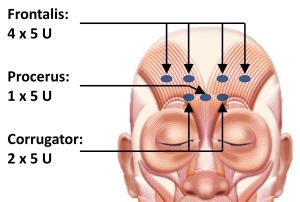
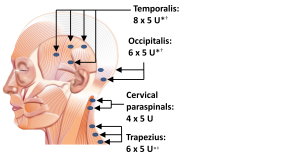
*Additional Units of BOTOX can be administered per physician’s discretion. †Up to an additional two doses (2 x 5 Units). ‡Up to an additional 4 doses (4 x 5 Units).
Reference: Blumenfeld A et al. Headache 2010; 50:1406–18
How long will it take?
The treatment will take about 20 minutes.
How will I feel immediately after the treatment?
Everyone is different, but most people will feel quite well, except for some very mild pain around the injection sites.
Will I need any help travelling home from hospital?
No, you can travel to and from the hospital as you would for any appointment.
How long will it take to work?
Botox usually takes between four and seven days to have any effect, but the benefits of each treatment may last several months. When Botox was tested in clinical trials, the average patient found that they had a reduction of eight headache days per month after two sets of injections.
How often will I have to come to the hospital? Treatment will be offered about every four to five months.
Botox and pregnancy
It is not wise to become pregnant while having Botox treatment. If you are pregnant, or wish to become pregnant, please speak to your headache doctor or consultant. Breastfeeding with Botox treatment is also not advised.
Are there any other options?
This is the treatment recommended by your consultant. We must seek your consent for any treatment or procedure beforehand. Staff will explain the risks, benefits and alternatives where relevant before they ask for your consent. If you are unsure about any aspect of the treatment proposed, please do not hesitate to ask for more information. If you wish to discuss any other options, please speak to your consultant, headache doctor or nurse.
What do I do if I feel unwell?
During working hours, you can contact the Pain Helpline on 01384 244735.
For anything you consider to be an emergency, please contact your GP or the emergency services.
If you have any questions, or if there is anything you do not understand, please contact the Russells Hall Hospital switchboard number on 01384 456111 and ask for the relevant department who issued this leaflet.
If you have any feedback on this patient information leaflet please email dgft.patient.information@nhs.net
This leaflet can be made available in large print, audio version and in other languages, please call 0800 073 0510.
Originator: Ruth Carter. Date originated: March 2019. Date reviewed: October 2024. Next review due: October 2027. Version: 3. DGH ref: DGH/PIL/02050.