
Anaesthetic Services at The Dudley Group
This leaflet will give you information about the benefits and risks to help you make an informed decision about undergoing a fascia iliaca block procedure.
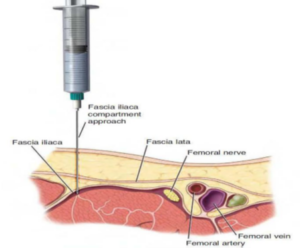
It is an injection of local anaesthetic medication near the hip that numbs the nerves supplying the hip and thigh. It should give you pain relief from your broken hip for up to 10 hours, whilst you are awaiting surgery. This injection can be given while you are awake.
A nurse or doctor trained in giving the injection will ask you to lie on your back so
that the groin area on the side of your broken hip can be accessed. The skin on your groin will be cleaned (this may feel a bit cold) and you will then have a small injection to numb the skin. A deeper second injection will then numb the nerves supplying the hip and thigh.
The first injection to the skin will sting for a few moments, just like an injection at the dentist, but this will make the area numb so that the nurse or doctor can put the
second needle in with minimal discomfort.
The whole procedure should not be painful but it can be uncomfortable positioning you for the injection. If you feel pain you should let the nurse or doctor know.
This is usually within 30 minutes but every patient is different.
The block provides pain relief to the area of the fracture, reducing the need for other
strong drugs such as morphine, which can have side effects such as sickness, drowsiness and chest or breathing problems.
Side effects are very rare but may include:
If you get any of the above symptoms including pain at the site of injection please let the staff know as soon as possible. They will be assessing you continually whilst performing the injection.
If you are taking Direct Oral Anti Coagulant DOAC medication – Rivaroxaban, Apixaban, Edoxaban, Dabagitran – Warfarin or other blood thinning agents, or have a known blood clotting disorder you may not be suitable for this injection. Your clotting status will have to be checked on admission to see if you are suitable for the injection. If you have forgotten to tell the staff please let them know as soon as possible.
If you choose not to have the injection you will be given alternative pain relief for your broken hip until you have surgery. This is likely to be morphine medication.
If you have any questions that this leaflet does not answer please ask your nurse practitioner, doctor or any member of the health care team.
Originator:Caroline Moody. Review date: January 2027. Version: 1. DGH ref: DGH/PIL/01443