
Ophthalmology
Laser treatment for glaucoma – selective laser trabeculoplasty (SLT)
Patient Information Leaflet
Introduction
This leaflet has been written to help you understand more about a type of laser treatment for glaucoma that has the medical name selective laser trabeculoplasty.
It explains what the treatment involves, the benefits and risks of it and what you should do afterwards. This information is designed to help you decide whether you would like this treatment and to make you aware of what to expect when you come to hospital.
What is glaucoma?
Glaucoma is an eye disease that can affect sight, usually due to a
build-up of pressure within the eye. This eye pressure is known as intraocular pressure (IOP). If it is not treated or if treatment is delayed, it can cause blindness.
A fluid (called aqueous humour) is produced inside the eye. This fluid is needed to
- Provide nutrients to the front of the eye, especially the cornea and lens.
- Remove waste products from the eye.
The fluid drains mainly through a structure called the trabecular meshwork. This meshwork lies inside the eye in the angle where the cornea meets the iris.
The normal pressure in the eye is between 10 and 21 millimetres of mercury (mmHg). If for any reason the fluid flow is blocked and cannot normally get out, the pressure can rise and glaucoma may occur.
What treatment options and alternatives are there?
There are various treatment options, including tablets, eye drops, laser treatment and drainage surgery, which includes trabeculotomy, iStent, trabeculectomy and glaucoma tube surgery. Your consultant will discuss all the possible options with you and you can decide which option you prefer. Eye drops and laser trabeculoplasty are by far the most commonly used initial treatments.
You do not have to have treatment – it is ultimately your decision. However, if glaucoma is not treated, it may eventually cause blindness.
Please note that almost all glaucoma treatments and procedures, including laser treatments, are used to control / slow down glaucoma and not to improve your vision. Once vision is lost from glaucoma, you cannot get it back. All treatment for glaucoma is aimed at slowing down the rate of progression of glaucoma, to reduce the risk of complete blindness during your lifetime.
What is selective laser trabeculoplasty (SLT)?
A laser is used to treat the trabecular meshwork to improve drainage of eye fluid through the meshwork. The aim of this treatment is to reduce pressure in your eye.
The advanced laser system is used to target only the melanin-rich (pigmented) cells in the drainage channel of the eye. This means that only these cells are affected and the surrounding tissue is left intact and unharmed. This gentle laser treatment activates the body’s own immune system to clear the affected cells.
It is not a permanent treatment and may need to be repeated in the future to continue to control eye pressure effectively.
Why is this treatment recommended?
NICE (National Institute for Health and Clinical Excellence) recommendations on treatment for OHT (ocular hypertension) and POAG (primary open angle glaucoma) as an option for patients who have:
- Raised eye pressure with open angle and who are at risk of glaucoma.
- A type of glaucoma called open-angle glaucoma where there is resistance to fluid draining out at the trabecular meshwork.
- Glaucoma that continues to get worse despite using eye drops.
- Glaucoma in the early stages.
- It is best to treat both eyes at the same time if eligible.
What are the benefits?
SLT can lower raised pressure in the eye (IOP) without the side effects or difficulty of taking eye drops. The treatment is particularly suitable for people who cannot correctly use, or are intolerant to glaucoma medications. It can also be used alongside medication to give a better IOP-lowering effect. Recently, it has been shown to be somewhat more effective and cheaper than the use of eye drops.
SLT has the advantage of not causing any damage to the tissue treated. It is a flexible treatment option and can be repeated if necessary, if you wish.
How successful is it at lowering intraocular pressure (IOP)?
Studies show that there is a success rate of about 80 per cent for SLT, which is four out of five patients. Most patients responded well to the treatment, but others did not respond at all.
Usually, we cannot predict how well the laser will work as it depends on how severe your glaucoma is and what type you have, as well as the individual characteristics of your eye.
It might take from a few weeks to a few months to see how your eyes have responded to the SLT treatment. If your eye pressure does not decrease enough after the first treatment, you may need to have more laser treatment about six months later, or you may need to use some additional eye drops.
The effects of the laser treatment may wear off in time – about half of all treatments stop working after five years. However, the treatment can be repeated as required.
What are the risks?
As with all treatment, SLT carries some risks and complications. It is important that we tell you about these risks so that you have the information you need to make a decision about it.
SLT has a safety track record for over two decades; however, there are some rare side effects that may occur:
- Your vision may be blurred for a few hours after the treatment. However, the chance of your vision being permanently affected from SLT is extremely small. If you are concerned that your vision is not returning to normal, please contact the Urgent Referral Clinic. Due to this, you are also advised not to drive yourself to the hospital, as you may be unable to drive home.
- It is possible that the pressure in your eye may increase immediately after the treatment. We will give you special eye drops to prevent this from happening.
Unlike some glaucoma medications, with SLT there are no reports of allergic reactions or side effects that affect your whole body. Other complications may include inflammation, a headache, iritis (inflammation of the iris in your eye), swelling of the cornea, conjunctivitis or eye pain.
What happens during the treatment?
Treatment takes place in the Eye Clinic outpatient department. A nurse will check your vision. You will then be seen by an eye doctor who will put some drops into your eye to make your pupil small and to prevent and blunt the possible pressure spiking effect of the laser.
These drops may take up to half an hour to work and may cause temporary brow ache and a headache. The doctor will also explain the treatment to you and discuss any concerns or questions you may have. If you are happy to proceed with the treatment, you will need to sign a consent form.
After this, you will need to sit in front of the laser machine which looks similar to the slit lamp used to examine your eyes in clinic (see figure 1). The eye doctor will put anaesthetic drops into your eye to numb the front of it. These drops may sting slightly for a few seconds before the front of your eye goes numb.
The eye doctor will then put a special lens, a bit like a contact lens, against the front surface of your eye. This is not painful but it may feel a little strange and rarely, in some cases, it may cause some redness or irritation in your eye.
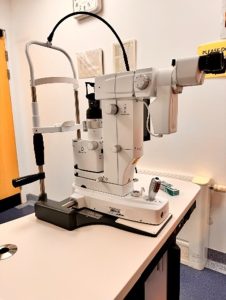
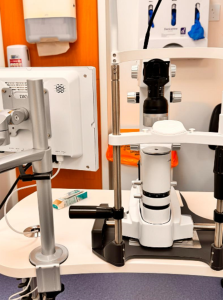
Picture shows the laser Picture shows the laser
from side view from patient’s view
Photographs taken by Mr A Raj, Consultant ophthalmologist.
It is very important for you to be seated comfortably with your chin on the chin rest of the laser machine. You will need to have your forehead pressed against the forehead band of the machine. You must stay very still during the laser procedure. Any movement might defocus the laser and it may not work as well as it could.
During the laser treatment, you might see some flashes of light and hear clicking noises. Most patients tolerate the laser treatment well, but some might feel slight discomfort.
How long does it take?
The treatment itself takes between 15 and 20 minutes; however, the whole visit may take a few hours.
What happens after the treatment?
The doctor will put some more pressure-lowering drops into your eye at the end of the laser treatment and will re-check your eye pressure up to one hour later.
Follow up
We will make an appointment for you to come back to the Eye Clinic, usually within four weeks of your treatment. This follow-up appointment is to check your eye pressure and that your eye is settling after the treatment.
What do I need to do at home?
You can carry on as normal when you get home. You will not have a patch over your eye. You will not be given any more eye drops to use.
What should I look out for at home?
If you have any of the following after treatment:
- Reduced vision or loss of vision.
- Severe pain that does not go away.
- Any abnormal discharge from your eye, especially if it is increasing.
Please contact the Urgent Referral Clinic team at Russells Hall Hospital Eye Clinic on 01384 456111 ext. 3633.
Can I find out more?
You can find more information on glaucoma, on the risk of blindness from glaucoma and various treatment options from the following websites:
Google search for: NICE Glaucoma Guidelines
Google search for: NICE Guidelines on Selective Laser Trabeculoplasty (SLT)
http://www.ophthalmologyweb.com/Tech-Spotlights/35290-Ten-Years-of-Selective-Laser-Trabeculoplasty/
http://www.ophthalmologyweb.com/Tech-Spotlights/35290-Ten-Years-of-Selective-Laser-Trabeculoplasty/
http://www.glaucoma-association.com/
http://www.glaucoma-association.com/about-glaucoma/what-is-glaucoma
http://www.nei.nih.gov/health/glaucoma/glaucoma_facts.asp
http://www.rnib.org.uk/eyehealth/eyeconditions/eyeconditionsdn/Pages/glaucoma.aspx
http://en.wikipedia.org/wiki/Glaucoma
http://www.nice.org.uk/guidance/cg85/ifp/chapter/About-this-information
https://www.rcophth.ac.uk/patients/glaucoma/
What if I have any problems or questions after reading this leaflet?
If there is anything you do not understand, or you are concerned or worried about any part of the treatment, contact:
The Urgent Referral Clinic team at Russells Hall Hospital Eye Clinic on 01384 456111 ext. 3633 (9am to 4.30pm, Monday to Friday).
Eye emergency, out of hours
In case of an eye emergency after the closing hours of the Eye Clinic at Russells Hall (including weekends and bank holidays), please contact:
Birmingham and Midland Eye Centre on 0121 507 4440
The doctor on call is usually based at the Eye Centre, City Hospital, Dudley Road, Birmingham. They may need to call you back, and if necessary, they will arrange for you to visit them.
Note: the information in this booklet is provided for information only. The information found is not a substitute for professional medical advice or care by a qualified doctor or other health care professional. Always check with your doctor if you have any concerns about your condition or treatment. This is only indicative and general information for the procedure. Individual experiences may vary and all the points may not apply to all patients at all times. Please discuss your individual circumstances with your eye doctor.
Author:
Mr Akash Raj, MD, MRCS, DRCOphth, FRCS, FRCOphth
Consultant ophthalmologist (glaucoma lead)
Reference
Realini T (2008). Selective laser trabeculoplasty: a review. J Glaucoma. 17 (6):497-502.
Wong MO, Lee JW, Choy BN, Chan JC and Lai JS (2015). Systematic review and meta-analysis on the efficacy of selective laser trabeculoplasty in open-angle glaucoma. Surv Ophthalmol. 60(1):36-50.
If you have any questions, or if there is anything you do not understand, please contact the Russells Hall Hospital switchboard number on 01384 456111 and ask for the relevant department who issued this leaflet.
If you have any feedback on this patient information leaflet please email dgft.patient.information@nhs.net
This leaflet can be made available in large print, audio version and in other languages, please call 0800 073 0510.
SLT/AR/ST/DP/09.2024/v4 – review 06.2027 DGH/PIL/01149