
Ophthalmology
Minimally invasive glaucoma surgery (MIGS) – iStent inject implant
Patient Information Leaflet
Introduction
This leaflet has been written to help you understand more about the surgery for glaucoma known as an iStent inject implant. It explains what the operation involves, the benefits and risks of it, and what you should do afterwards.
This information is designed to help you decide whether you would like this surgery, and to make you aware of what to expect when you come to hospital.
What is glaucoma?
Glaucoma is an eye condition that can affect sight, usually due to a build-up of pressure within the eye. This eye pressure is known as intraocular pressure (IOP). If it is not treated or if treatment is delayed, it can cause blindness.
A fluid (called aqueous humour) is produced inside the eye. This fluid is needed to:
- Provide nutrients to the front of the eye, especially the cornea and lens.
- Remove waste products from the eye.
The fluid drains mainly through a structure called the trabecular meshwork. This meshwork lies in the angle where the cornea meets the iris.
The normal pressure in the eye is between 10 and 21 millimetres of mercury (mmHg). If, for any reason, the fluid is blocked and cannot get out, the pressure can rise and glaucoma may occur.
What treatment options and alternatives are there?
There are various treatment options including tablets, eye drops, laser treatment and drainage surgery, which includes trabeculectomy, iStent inject implants and Baerveldt glaucoma tube implantation. Your consultant will discuss all of the possible options with you and you can decide which option you prefer.
You do not have to have treatment – it is your decision. However, if glaucoma is not treated, it may cause blindness.
Please note that almost all glaucoma treatments and procedures, including laser treatments, are used to control glaucoma and not to improve your vision. Once vision is lost from glaucoma, you cannot get it back. All treatment for glaucoma is aimed at slowing down the rate of progression of glaucoma, to reduce the risk of complete blindness during your lifetime.
What is iStent inject drainage implant surgery?
iStent inject surgery is a relatively new procedure that involves inserting two tiny hollow metal tubes (stents) into the trabecular meshwork in the eye. The fluid can then drain through these tubes from the front chamber of the eye into the Schlemm’s canal and out of the eye. This helps to reduce pressure inside the eye. The Schlemm’s canal is a collector channel around the iris root in the front of the eye.
Reducing pressure on the optic nerve in this way can help slow down further damage and loss of vision in glaucoma.
The iStent injects are tiny titanium devices that look like a small compressed connecting screw (see figures 1a, 1b and 2a). It is currently the smallest device implanted in a human body.
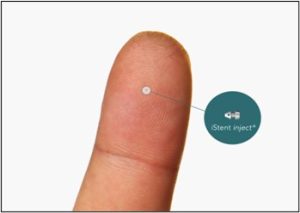
Figure 1a: iStent inject – as a small mole on your fingertip
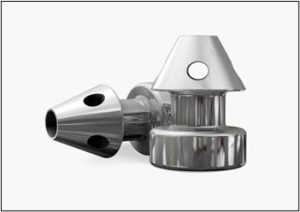
Figure 1b: enlarged version
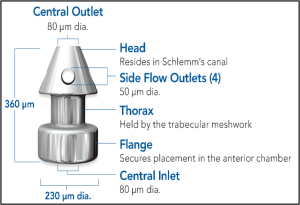
Figure 2a: dimensions of an iStent inject
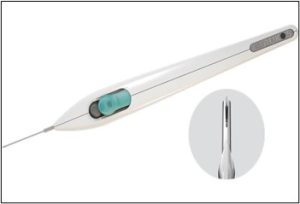
Figure 2b: iStent injector
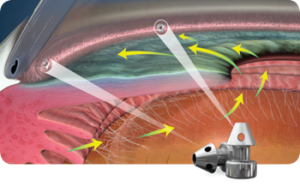
Figure 3a: drainage through iStents
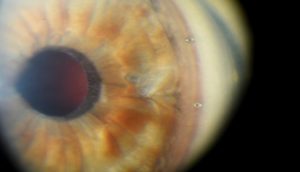
Figure 3b: iStents inside an eye
All images are courtesy Glaukos UK
Dimension of the iStent inject:
- Height: 36 mm (less than half the size of a grain of rice)
- Width: 0.23 mm
It can be performed as a standalone procedure, but it is mostly performed in combination with cataract surgery. It is just as efficient at reducing eye pressure as the best glaucoma medications, and it avoids the side effects of eye medication.
Why is this operation recommended?
iStent inject drainage implant surgery is approved to treat moderate to advanced open-angle glaucoma in people who are already using medication to reduce high pressure in the eye.
The iStent drainage implant cannot be used in patients with:
- Narrow-angle glaucoma and certain other secondary glaucomas (neovascular glaucoma, traumatic glaucoma and malignant glaucoma etc.). Secondary glaucoma is where the cause of increased eye pressure can be linked to other eye conditions, operations, injuries or medications.
- Tumours of the optic nerve, chronic inflammatory disease, thyroid eye disease, retrobulbar tumour, Sturge-Weber syndrome or any other conditions where the trabecular meshwork, Schlemm’s canal or collector channels are affected.
We can advise you on your suitability for this procedure and give you any further information you need.
What are the benefits?
This operation will not improve your vision or cure glaucoma, but it aims to slow down further visual loss from glaucoma damage. The goal is to reduce the risk of blindness from glaucoma in your lifetime.
Other benefits of iStent inject are:
- It is a less invasive surgery compared to other more complex drainage surgeries, and it has a faster recovery time.
- It provides an extra option for controlling glaucoma where glaucoma medications, laser treatments or other complex glaucoma surgeries are not appropriate.
- The stent is made from non-ferromagnetic titanium, the same material used for replacing heart valves, so it will not be rejected by your body and it does not cause an allergic reaction. It will not set off airport scanners and it will not cause any problems if you need to have an MRI scan.
However, the iStent injects will not cure your glaucoma, reverse any damage already caused by glaucoma, or recover lost vision.
How successful is it at lowering intraocular pressure (IOP)?
Numerous studies have demonstrated that iStent inject is effective in lowering eye pressure and can reduce medication burden. In one study, the mean eye pressure was reduced by 34 per cent, and the average medication usage was reduced from 1 to 0.1. The Synergy study showed an eye pressure reduction of ≥20 per cent in 74 per cent of patients at 12 months after iStent surgery without elimination of medication.
Safety of the iStent
The iStent has been approved by the United States Food and Drug Administration (US FDA) and has been CE marked in Europe. There have been no reports of significant or persistent side effects noted so far.
What are the risks?
As with all surgery, this operation carries some risks and complications. It is important that we tell you about these risks so that you have the information you need to make a decision about the operation.
There could be a risk of the stent becoming blocked or coming out of position. It may not provide long term glaucoma control and there may be failure and or loss of effect with time.
As with all eye surgery, it also carries the risk of reduced vision or a loss of vision, pain, bleeding, infection and inflammation in the eye. It is possible that you may need further procedures or treatment if it fails to control your eye pressure.
What happens before the operation?
You should continue any eye drops and tablets for your glaucoma as prescribed, until the time of your surgery, unless directed otherwise specifically.
If you are taking any blood-thinning tablets (such as warfarin or aspirin), they might increase the risk of bleeding during the operation. You should discuss this with your glaucoma team. They may advise you to stop them for a period of a few days to up to a week before the surgery, if this would not affect your general health.
What happens during the operation?
This operation is performed as a day case procedure where you will only need to be in hospital for the day. The doctor will explain the treatment to you and discuss any concerns or questions you may have with you. If you are happy to proceed with the treatment, you will need to sign a consent form.
After this, we will put local anaesthetic solution into the tissue surrounding the eye. To do this, we will put numbing drops into your eye and, when your eye is numb, we will inject the anaesthetic into the tissue around your eye. You may feel pressure when we do this, but it is not usually painful.
The surgeon will make a small cut in the cornea of your eye. The angle where the cornea meets the iris is opened using a jelly-like substance called viscoelastic.
This is injected into a part of the eye known medically as the anterior chamber. The anterior chamber is the fluid-filled space inside the eye between the iris and the cornea’s inner surface.
The surgeon will then insert the iStent injects (using an iStent injector – see figure 2b) through the trabecular meshwork and into the Schlemm’s canal. The actual iStent injects are almost invisible.
The position of the stent is checked, the injector is taken out and the viscoelastic is removed. Two iStent injectors are inserted during the procedure.
If the operation is going to be combined with cataract surgery, you will be given another information leaflet about this.
How long does it take?
The procedure is relatively short, taking about 30 minutes. When combined with cataract surgery, the procedure will usually take approximately 50 to 60 minutes. It is commonly combined with cataract surgery.
What happens after the operation?
Immediately after your operation, your eye will be covered by an eye pad and protective plastic shield.
You will be given two eye drops to use in the operated eye. One of them is to be used four times a day for four weeks, and the other is to be used three times a day for three weeks. The team will make an appointment for you to be reviewed in the glaucoma clinic the next day and then a week later.
The iStent should start working soon after surgery, or at least within the next few weeks. At this point, your eye surgeon will look at the possibility of reducing your eye drop medications.
What should I look out for at home?
If you have any of the following after surgery:
- Reduced vision or loss of vision.
- Severe pain that does not go away.
- Any abnormal discharge from your eye, especially if it is increasing.
Please contact the Urgent Referral Clinic team at Russells Hall Hospital Eye Clinic on 01384 456111 ext. 3633.
Follow up appointments
In order for us to check your eye, you will need to come to the Eye Clinic after one day, one week and later depending on your particular condition.
Can I find out more?
You can find more information on iStent drainage implants, glaucoma, the risk of blindness from glaucoma and various treatment options from the following websites:
https://www.youtube.com/watch?v=OatIIxyHHjw
https://www.glaukos.com/en-uk/healthcare-professionals/istent-inject/
http://www.glaucoma-association.com/
http://www.glaucoma-association.com/about-glaucoma/what-is-glaucoma
http://www.nei.nih.gov/health/glaucoma/glaucoma_facts.asp
http://www.rnib.org.uk/eyehealth/eyeconditions/eyeconditionsdn/Pages/glaucoma.aspx
http://en.wikipedia.org/wiki/Glaucoma
http://www.nice.org.uk/guidance/cg85/ifp/chapter/About-this-information
https://www.rcophth.ac.uk/patients/glaucoma/
Voskanyan L, García-Feijoó J, Belda JI, Fea A, Jünemann A, Baudouin C; Synergy Study Group. Prospective, unmasked evaluation of the iStent® inject system for open-angle glaucoma: synergy trial. Adv Ther. 2014 Feb; 31(2):189-201. doi: 10.1007/s12325-014-0095-y. Epub 2014 Jan 23.
What if I have any problems or questions after reading this leaflet?
Please contact the Urgent Referral Clinic team at Russells Hall Hospital Eye Clinic on 01384 456111 ext. 3633 (9am to 4.30pm, Monday to Friday).
Eye emergency, out of hours
In case of an eye emergency after the closing hours of the Eye Clinic at
Russells Hall Hospital (including weekends and bank holidays), please contact:
Birmingham and Midland Eye Centre on 0121 507 4440
The doctor on call is usually based at the Eye Centre, City Hospital, Dudley Road, Birmingham. They may need to call you back, and if necessary, they will arrange for you to visit them.Note: the information in this booklet is provided for information only. The information found is not a substitute for professional medical advice or care by a qualified doctor or other health care professional. Always check with your doctor if you have any concerns about your condition or treatment. This is only indicative and general information for the procedure. Individual experiences may vary and all the points may not apply to all patients at all times. Please discuss your individual circumstances with your eye doctor.
Author:Mr Akash Raj, MD, MRCS, DRCOphth, PG Dip (Distinction), FRCS, FRCOphthConsultant ophthalmologist (glaucoma lead)
If you have any questions, or if there is anything you do not understand, please contact the Russells Hall Hospital switchboard number on 01384 456111 and ask for the relevant department who issued this leaflet.
If you have any feedback on this patient information leaflet please email dgft.patient.information@nhs.net
This leaflet can be made available in large print, audio version and in other languages, please call 0800 073 0510.
iStent/AR/ST/02.2025 v4 – review 06.2027 – DGH ref.: DGH/PIL/01154