The way we use patient data is changing: We aim to provide the highest quality care. To do this, we routinely collect information about you and the care you receive from us. Like other hospitals across England, we are changing how we share and use this data… Find out more

The Dudley Group NHS Foundation Trust Logo
Ellie Rathbone
25 March 2026

Critical Care Unit

What is Critical Care? Critical Care is a specialist area of the hospital where patients receive additional monitoring and support when they need closer attention. In Critical Care, a highly trained team look after patients around the clock. They use monitoring equipment to keep a close eye on things like breathing, heart rate, and blood […]

What is Critical Care?

Critical Care is a specialist area of the hospital where patients receive additional monitoring and support when they need closer attention.

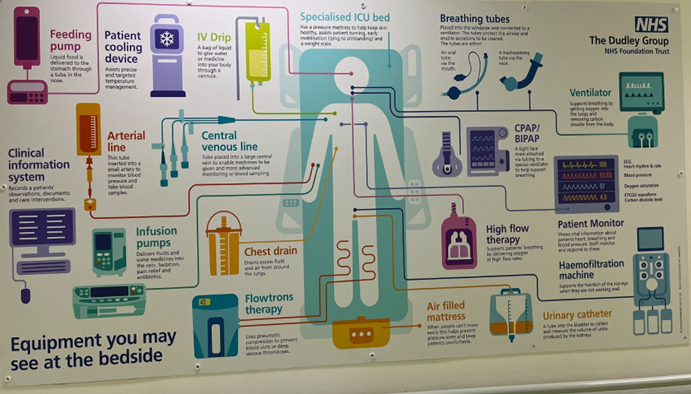
In Critical Care, a highly trained team look after patients around the clock. They use monitoring equipment to keep a close eye on things like breathing, heart rate, and blood pressure, so they can respond quickly if anything changes. These monitors can be noisy and alarm, these alarms are to alert the staff. Although we know they can be annoying they are vital for your safety and care. If noise and light is affecting your sleep/rest, please ask a member of staff for a sleep pack (eye mask and earbuds).

Why may you be admitted?

Patients may get admitted to critical care to support:

  • Recovery after surgery
  • Breathing support
  • Heart or blood pressure monitoring
  • Serious infections
  • Additional support while the body recovers from illness, injury or treatment
Layout of the unit:

Here on Critical Care, we have three areas,

Area A: 9 beds – two of which are side rooms

Area B: 6 beds

Area C: 8 beds – four of which are side rooms

Side rooms are for patients who have an infection or who are at high risk of catching an infection. We understand this can be isolating but it is for the safety of patients, yourself, staff and visitors.

There are televisions in Area B and in all rooms of Area C. There are patient toilets in Areas B and C only.

Our staff work across all three areas of the unit. You may be moved from one area to another depending on your care needs.

Who will look after you?

We have a multitude of staff who may see you. These people include (to name a few):

  • Consultants
  • Doctors
  • ACCPs (Advanced Critical Care Practitioners)
  • Nurses
  • CSW’s (Clinical Support Workers)
  • Student Nurses
  • Physiotherapists
  • Dietitians
  • Speech and language therapy
  • Pharmacists
  • Psychologists

We also use other teams of specialists when necessary.

Staff should introduce themselves and be identifiable through visible name badges. If you are unsure who someone is, please ask them.

Ward round happens every day and we have two ward rounds a day, AM and PM.

Information about visiting

Visiting is 11-8, to allow time for personal care, you to eat if able, the doctors to do their ward round and allow staff to complete medication rounds with minimal distractions to reduce error.

Visitors are asked to leave by 8pm to allow you time to rest and as this is vital to your progression and recovery. Between 1900-1930 when nurses are handing over, we ask relatives to leave the clinical area to maintain confidentiality for other patients.

Visiting can be flexible on an individual need/circumstance and should be discussed with the nurse in charge/lead nurse on duty.

Nutrition:

When you are unwell, your body needs extra energy and protein to recover, fight infection, and keep muscles working and you may experience taste changes.

We understand that it can be difficult to eat at times when you are not well, but good nutrition is important in Critical Care to help your body heal and regain strength.

If you are unable to eat well on your own, we may insert a tube called a nasogastric tube (NG) down your nose to your stomach where we can give you liquid food. You may not be able to eat normally after some surgeries, but we will keep you informed of your nutritional plan.

This is done to help you:

  • Heal faster
  • Maintain strength
  • Support breathing and movement
  • Reduce complications

If you are struggling with nutrition, please speak to a member of staff for alternative menu options.

Stepping down from Critical Care:

As you get to a level 0 (or level 1 in some cases) you will be deemed ‘wardable’ it is at this stage that we start looking for a ward bed for you. Due to hospital demands this may not happen on the same day.

You will be told which ward you are going to, and a comprehensive handover will be given to the ward staff.

You may be visited on the ward by our Critical Care Outreach Team (CCOT). One of these nurses will review your progress on the ward. When they feel you are no longer in need of these reviews they will discharge you from their list. This does not mean they will never see you again.

Ward staff and doctors can re-refer you to them and they will come and see you again if medically required. You may also be visited by the Critical Care Rehab Team if your level of care and complex needs fulfil their criteria for ongoing support.

Martha’s Rule

We want patients and families to feel heard and supported. Martha’s Rule gives you an extra way to ask for help if you are worried that your/your relatives condition is getting worse and feel your concerns have not been fully addressed. Find out more: Martha’s Rule – The Dudley Group NHS Foundation Trust

Ellie Rathbone
Jade Ball
16 March 2026

Community Paediatrics

Community Paediatrics at the Dudley Group NHS Foundation Trust provides comprehensive, child-centred care for babies, children and young people within their local community. Our service focuses on assessment, diagnosis, management and ongoing support for a wide range of developmental and health needs. We work closely with families, schools and partner agencies to ensure each child’s […]

Community Paediatrics at the Dudley Group NHS Foundation Trust provides comprehensive, child-centred care for babies, children and young people within their local community. Our service focuses on assessment, diagnosis, management and ongoing support for a wide range of developmental and health needs.

We work closely with families, schools and partner agencies to ensure each child’s needs are understood and supported across home, education and healthcare settings.


Our Approach

Specialised Expertise:

Community Paediatricians are trained in both hospital and community settings, offering a broad and unique perspective on children’s health and development. We work closely with acute paediatric teams to ensure continuity of care when children require hospital-based treatment.

Supporting a Wide Range of Needs:

We assess and support children and young people with:

  • Developmental delays
  • Neurodisability and complex neurological conditions
  • Neurodiversity, including autism and ADHD (suspected ADHD with moderate to severe learning disabilities need a referral to Learning Disability CAMHS service)
  • Chronic medical conditions
  • Learning disabilities
  • Child protection and safeguarding concerns

Joined-up Care, Multi-disciplinary care:

We collaborate with a wide range of professionals to provide co-ordinated care. This includes:

  • School and education staff
  • Speech and Language Therapy (SALT) teams
  • Dysphagia specialists
  • Occupational Therapists
  • Physiotherapists
  • Social workers
  • Hospice and palliative care teams
  • Autism assessment services
  • Child and Adolescent Mental Health Services (CAMHS) Specialists
  • Hospital-based experts
  • Health visitor


Our goal is to ensure children receive the right support, from the right professionals, at the right time.

Family-Focused Support:

We place families at the centre of care. Our team provides advice, guidance and practical support to help parents and carers understand their child’s needs and access appropriate services and resources.

Referral and Assessment:

Referrals are usually made by GPs or other healthcare professionals.

For children under 5, referrals are triaged through a multidisciplinary Single Point of Access, helping ensure each child is directed to the most appropriate service from first contact.

Assessments may include:

  • Detailed discussions with parents or carers
  • Observation of the child
  • Review of medical, educational and relevant background information


Long-term Management and Ongoing Care:

Community Paediatricians play a key role in the long-term management of children with chronic conditions or disabilities. We work closely with specialist and palliative care teams, including hospice services, to provider co-ordinated, compassionate care for children with complex or life-limiting conditions.


Conditions and Services We Support

Our service provides assessment, advice and management for:

  • Developmental Delays: Assessments and interventions for children who are not developing at the expected pace.
  • Neuro-disability: Care for children with conditions like cerebral palsy, autism, and attention-deficit/hyperactivity disorder (ADHD).
  • Learning Disabilities: Support for children with learning difficulties.
  • Child Protection: Addressing concerns about child safety and wellbeing.
  • Special Educational Needs: Advice and support for children with special educational needs.
  • Hearing problems: Assessment and management of hearing problems.
  • Looked After Children: Supporting children in the care system.
  • Adoption and Fostering: Advice and support for families involved in adoption and fostering.
  • Vision Impairment: Assessment and management of vision impairment.
  • Complex Neuro-disability: Care for children with complex neurological conditions.
  • Palliative Care: Support for children with life-limiting conditions.


What does the service not offer?

  • General medical conditions such as asthma, eczema or headaches
  • Autism assessments or diagnosis over the age of 5
  • Behavioural issues (this should initially be referred to Family Support Services). We may offer an initial medical assessment, but we are not able to provide on-going behaviour management support.
  • Emotional health and wellbeing support.
  • Dyslexia and specific learning difficulties.
  • Obesity and growth problems (please contact your GP for support with this).
  • Constipation
  • Sleep (where this does not form part of broader neurodevelopmental support).
  • Diagnosing Learning Disability.
  • Suspected ADHD with moderate to severe learning disabilities.


If you are waiting for a new or follow up appointment and you are concerned about your child’s health please contact your GP, call 111 or 999 if an emergency.

Jade Ball
Sam Beeken
19 December 2025

Day Surgery Unit

On behalf of the team who will be caring for you, we would like to take this opportunity to welcome you to the Day Surgery Unit.  The unit is managed by speciality manager Angela Larkin, alongside her team of experienced nurses, health care assistants and ward clerks. Our elective Day Surgery Unit treats over 13,000 […]

On behalf of the team who will be caring for you, we would like to take this opportunity to welcome you to the Day Surgery Unit.  The unit is managed by speciality manager Angela Larkin, alongside her team of experienced nurses, health care assistants and ward clerks.

Our elective Day Surgery Unit treats over 13,000 patients a year from a variety of specialities to enable patients to have their surgery with an aim to discharge the same day.  Surgery is scheduled for morning, afternoon and evening theatre lists.

Please note your arrival time is not your surgery time, you may be expected to wait a number of hours before going to surgery, so please bring a book, puzzles etc to help occupy you.  We will aim to keep you updated throughout your stay, but if you have any concerns please speak to your nursing staff.

Useful patient information links:

How to access the service

Telephone numbers

  • 01384 456111 ext.1848 or 1886
  • Pre-operative Assessment – 01384 456111 ext. 3301

Useful Information – limit to (if relevant) location, contact details and opening hours – these will feature on the right-hand side

This service is available at:

  • Russells Hall Hospital

Where to find us

  • Day Surgery Unit, 1st Floor, West Wing, Russells Hall Hospital

Key staff 

Management team

  • Angela Larkin,  Lead Nurse

Nursing leads

  • Simon Gregory, Matron

Patient information leaflets

Sam Beeken
Hannah Jones
16 October 2025

Zenker Diverticulum – Patient Case Studies

Hannah Jones
Hannah Jones
15 October 2025

Cancer Treatments

When you have been diagnosed with cancer it can be very over whelming. This page will provide information around types of cancer treatments. Your case and results will be discussed at a multidisciplinary team meeting (MDT), where a group of health of professionals including a MDT coordinator, consultants, histopathologist, radiologist, oncologist and clinical nurse specialists […]

When you have been diagnosed with cancer it can be very over whelming. This page will provide information around types of cancer treatments.

Your case and results will be discussed at a multidisciplinary team meeting (MDT), where a group of health of professionals including a MDT coordinator, consultants, histopathologist, radiologist, oncologist and clinical nurse specialists who specialise in the type of cancer you have been diagnosed with.

Your treatment depends on the type of cancer you have been diagnosed with, your fitness levels, past medical history, choice and general well-being. Not all treatments are an option for every patient who has cancer. Your clinical team will discuss with you what treatments are an option for you. There are different types of cancer treatment and understanding how they work, how they are administered, and the side effects can help prepare you to cope. Below you will find the main treatments available for cancer treatments.

Hannah Jones
Hannah Jones
15 October 2025

Cancer Teams

Across the Trust we have several teams covering various forms of cancer. Please find further details below.

Across the Trust we have several teams covering various forms of cancer. Please find further details below.

Hannah Jones
Hannah Jones
15 October 2025

Living with and Beyond Cancer (LWBC)

The Living with and Beyond Cancer (LWBC) team are here to support you through your cancer diagnosis and beyond. The team provides holistic needs assessments, information, support and signposting to other services and organisations, as well as facilitating cancer information events.

The Living with and Beyond Cancer (LWBC) team are here to support you through your cancer diagnosis and beyond. The team provides holistic needs assessments, information, support and signposting to other services and organisations, as well as facilitating cancer information events.

Hannah Jones
Francesca Hart
29 July 2025

Tongue Tie Assessment

If you suspect your baby of having a tongue tie (sometimes known as frenulotomy or ankyloglossia), or if a tongue tie has been diagnosed by a health professional, a referral may be made to our midwife tongue tie practitioners. We only accept referrals from health professionals and then arrange an appointment. On our receipt of […]

If you suspect your baby of having a tongue tie (sometimes known as frenulotomy or ankyloglossia), or if a tongue tie has been diagnosed by a health professional, a referral may be made to our midwife tongue tie practitioners. We only accept referrals from health professionals and then arrange an appointment. On our receipt of the fully completed form, a telephone triage appointment will be booked, you will receive a text with details of the call. The referral must be made by completing the Tongue-Tie Referral Form and forwarding by email to: dgft.tonguetie.assessment@nhs.net. Please ensure the form is fully completed as all details are required to book an appointment.

During the telephone call, we will assess the need for you to attend an appointment at the Tongue Tie clinic. Clinics are held twice a week and are located on the ground floor of Russells Hall Hospital in the Paediatric area of the Women and Children’s Outpatient Department. This is the first department on the left if you enter the hospital by the Maternity entrance.

If your baby was born at Russells Hall Hospital or you live in the Dudley borough, please contact the infant feeding team who will provide you with feeding support and assess your baby for tongue tie. The team can be contacted by calling 01384 456111 ext. 3887 or emailing dgft.spmwif@nhs.net.

Francesca Hart
Francesca Hart
29 July 2025

Bottle Feeding

If you make the informed decision to bottle feed your baby it is important to learn how to do so safely. https://www.unicef.org.uk/babyfriendly/baby-friendly-resources/bottle-feeding-resources/guide-to-bottle-feeding/ The above link has all the necessary information regarding sterilising feeding equipment and preparing infant formula. If you are bottle feeding it is recommended that you use first infant formula for the first […]

If you make the informed decision to bottle feed your baby it is important to learn how to do so safely.

https://www.unicef.org.uk/babyfriendly/baby-friendly-resources/bottle-feeding-resources/guide-to-bottle-feeding/

The above link has all the necessary information regarding sterilising feeding equipment and preparing infant formula.

If you are bottle feeding it is recommended that you use first infant formula for the first year. For information regarding which milk to choose:

https://www.unicef.org.uk/babyfriendly/baby-friendly-resources/bottle-feeding-resources/infant-formula-responsive-bottle-feeding-guide-for-parents/

It is important that the baby’s parents give most of the baby’s bottle feeds, as this will help build up a close and loving relationship between you. Offer the bottle in response to signs that you baby is ready to feed, gently invite baby to take the teat and pace the feeds to meet the baby’s needs.

Make snuggling up and bottle feeding your baby a special time for you both. While you are feeding your baby maintain eye contact and cradle him. This will help your baby feel safe and loved.

If you are planning to bottle feed please bring a formula starter pack into hospital.

https://www.unicef.org.uk/babyfriendly/baby-friendly-resources/breastfeeding-resources/maximising-breastmilk-video/

Francesca Hart
Francesca Hart
29 July 2025

Breast Feeding

Dudley Group NHS Foundation Trust run regular breastfeeding workshops classes to help pregnant woman and their families prepare for feeding and caring for their new baby. We strongly recommend attending however you think you might feed your baby. To book please call 01384 244358 between 10am-12noon Monday-Friday. You can also view the breastfeeding workshop here. What […]

Dudley Group NHS Foundation Trust run regular breastfeeding workshops classes to help pregnant woman and their families prepare for feeding and caring for their new baby. We strongly recommend attending however you think you might feed your baby. To book please call 01384 244358 between 10am-12noon Monday-Friday.

You can also view the breastfeeding workshop here.

What happens in your baby’s first years of life has a big impact on how healthy he will be in the future.

Breastfeeding provides everything your baby needs in terms of nutrition, protection and comfort.

Colostrum is the yellowish, sticky breastmilk produced at the end of pregnancy. It is recommended by WHO (World Health Organisation) as the perfect food for newborn babies and feeding should be initiated within the first hour after birth.

Exclusive breastfeeding is recommended up to 6 months of age, with continued breastfeeding along with appropriate complementary foods up to two years of age or beyond. There are many benefits to breastfeeding:

https://www.nhs.uk/conditions/pregnancy-and-baby/benefits-breastfeeding/#close

All midwives and maternity support workers receive regular training to help you get your breastfeeding journey off to the best start.

https://www.unicef.org.uk/babyfriendly/baby-friendly-resources/breastfeeding-resources/positioning-and-attachment-video/

https://www.unicef.org.uk/babyfriendly/baby-friendly-resources/breastfeeding-resources/off-to-the-best-start/

There is lots of support available within the Dudley borough once you have left hospital. In addition to the support you will receive from your community midwife and health visitor, Dudley breastfeeding peer support run regular groups throughout the week for more information:

https://www.facebook.com/dudleybreastfeeding/

Francesca Hart