
Ophthalmology
Introduction
This leaflet has been written to help you understand more about the surgery for glaucoma known as Trabeculotomy. It explains what the operation involves, the benefits and risks of it and what you should do afterwards.
This information is designed to help you decide whether you would like this surgery, and to make you aware of what to expect when you come to hospital. You might decide to have this procedure, to have a different procedure, or not to have a procedure at all.
What is glaucoma?
Glaucoma is an eye disease that can affect sight, usually due to a
build-up of pressure within the eye. This eye pressure is known as intraocular pressure (IOP). If it is not treated or if treatment is delayed, it can cause blindness.
A fluid (called aqueous humour) is produced inside the eye. This fluid is needed to
The fluid drains mainly through a structure called the trabecular meshwork.
This meshwork lies inside the eye in the angle where the cornea meets the iris. The normal pressure in the eye is between 10 and 21 millimetres of mercury (mmHg). If for any reason the fluid flow is blocked and cannot normally get out, the pressure can rise and glaucoma may occur.
What treatment options and alternatives are there?
There are various treatment options, including laser treatment, eye drops, tablets and drainage surgery, which includes trabeculotomy, iStent, trabeculectomy and glaucoma tube surgery. Your consultant will discuss all the possible options with you and you can decide which option you prefer. Eye drops and laser trabeculoplasty are by far the most commonly used initial treatments.
You do not have to have treatment – it is ultimately your decision. However, if glaucoma is not treated, it may eventually cause blindness.
Please note that almost all glaucoma treatments and procedures, including laser treatments, are used to control / slow down glaucoma and not to improve your vision. Once vision is lost from glaucoma, you cannot get it back. All treatment for glaucoma is aimed at slowing down the rate of progression of glaucoma, to reduce the risk of complete blindness during your lifetime.
What is trabeculotomy surgery?
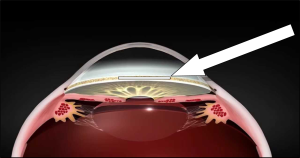
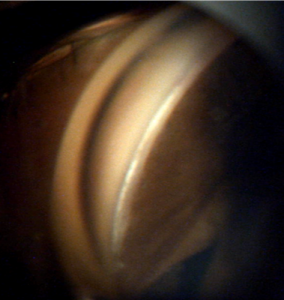
Trabeculotomy is a surgical procedure where a small and thin strip of tissue (the trabecular meshwork – Figure 1a and 1b on the next page) is removed to improve the drainage of fluid from the eye. The medical name for this procedure is ‘trabeculotomy ab interno’.
The surgery is done through a tiny incision on the side of the eyeball, which avoids the need for a ‘bleb’ (which is a bit like a reservoir that fluid drains into) to be created. The procedure is carried out using a local anaesthetic. This new and secure opening allows fluid (aqueous humour) to drain out of the eye.
Reducing pressure on the optic nerve in this way can help slow down further damage and loss of vision in glaucoma. The procedure itself is relatively straightforward and quick to perform.
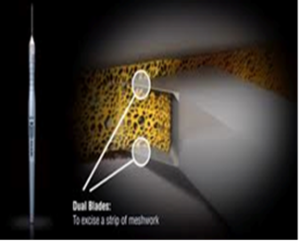
This procedure is performed using a novel dual blade device (Kahook Dual Blade, New World Medical, Rancho Cucamonga, California – Figure 2a). This is a disposable device. The surgery can be performed as a standalone procedure or combined with cataract surgery.
Why is this operation recommended?
Trabeculotomy surgery is approved to treat moderate to advanced open-angle glaucoma in people who are already using medication to reduce high pressure in the eye. This is one of the newer minimally invasive glaucoma surgeries (MIGS).
NICE (the National Institute for Health and Clinical Excellence) has advised that this procedure is safe enough and works well enough for us in the NHS.
Trabeculotomy is NOT advised for:
We can advise you on your suitability for this procedure and give you any further information you need.
What are the benefits?
This operation alone will not improve your vision or cure glaucoma, but aims to slow down further visual loss from glaucoma damage. The goal is to reduce your risk of blindness from glaucoma in your lifetime. When performed with a cataract operation, it will improve your vision by means of the removal of the cataract.
Other benefits of trabeculotomy are:
How successful is it at lowering intraocular (eye) pressure (IOP)? How well does the procedure work?
Three studies involving a total of 705 patients who had the procedure reported that the procedure was successful in 65 per cent to 91 per cent of patients, with pressure within the eye being reduced. Three studies involving a total of 1,762 patients reported that patients did not need as many glaucoma medications following the procedure. In two studies involving 2,516 patients who had the procedure, 361 needed further surgeries up to five years after the procedure.
As well as looking at these studies, NICE also asked expert advisers for their views. These advisers are clinical specialists in this field of medicine. The advisers said the main aim of the procedure is to reduce the pressure within the eye.
Safety and risks of trabeculotomy
Trabeculotomy is a relatively safe minimally invasive glaucoma surgery. As with all surgery, this operation carries some risks and complications (such as bleeding, infection, inflammation and reduced or loss of vision). It is important that you know about these risks so that you have the information you need to make a decision about the operation.
Expected hyphaema (bleeding into the anterior chamber of the eye) has been seen in 38 per cent of patients during surgery. This is very short-term, with almost all cases fully resolved by one to three weeks. This bleeding during trabeculotomy is actually a good indicator of its eventual success. There are extremely rare cases of iridodialysis and cyclodialysis. It is possible that you may need further procedures or treatment if it fails to control your eye pressure. This will be discussed during the clinic visit.
If you are happy to proceed with the treatment, you will need to sign a consent form in the clinic. Please note that as this procedure is usually combined with cataract surgery, and the usual risks of a cataract surgery would also apply (please see the cataract surgery information booklet).
What happens before the operation?
You should continue any eye drops and tablets for your glaucoma as prescribed, until the time of your surgery and after the surgery, unless directed otherwise specifically. You will be asked to use a couple of new eye drops three to four times a day for up to four weeks after surgery in the eye that will be having surgery.
If you are taking blood-thinning tablets (such as warfarin, aspirin, clopidogrel or rivaroxaban), they might increase the risk of bleeding during the operation. You should discuss this with your glaucoma team and your GP. They may advise you to stop them, if safe enough, for a few days to up to ten days before surgery if this will not adversely affect your general health.
What happens during the operation?
This operation is performed as a day case procedure, where you will only need to be in hospital for the day (not admitted overnight). The doctor will explain the treatment to you and discuss any concerns or questions you may have.
After this, we will put local anaesthetic solution into the tissue surrounding the eye. To do this, we will put numbing drops onto your eye and when your eye is numb, we will inject the anaesthetic into the tissue around your eye. You may feel a little pressure when we do this, but it is not usually painful.
Following this, you will be taken to the operating theatre where you will have to lie down flat for about 40 minutes when the surgery takes place.
How long does it take?
The procedure is relatively short, taking about 20 minutes. When combined with cataract surgery, the procedure will usually take approximately 40 minutes.
What happens after the operation?
Immediately after your operation, your eye will be covered by a protective plastic shield.
You will be given two eye drops to use in the operated eye; one of them is used four times a day for four weeks, and the other one is used three times a day for three weeks. The team will make an appointment for you to be reviewed in the glaucoma clinic the next day and after a week.
After your surgery, please ensure you wash your hands with soap and water before and after if: a) You are using any eye drops. b) You have an eye pad that you have been advised to remove yourself.
What should I look out for at home?
If you have any of the following after surgery:
Please contact the Urgent Referral Clinic team at Russells Hall Hospital Eye Clinic on 01384 456111 ext. 3633.
Follow up appointments
In order for us to check your eye, you will need to come to the Eye Clinic after one day, one week and later depending on your particular condition.
Where can I find out more?
You can find more information on trabeculotomy surgery from the following websites:
https://www.nice.org.uk/guidance/ipg397
https://www.youtube.com/watch?v=FoDy2-HTnt0
http://www.glaucoma-association.com
http://www.nei.nih.gov/health/glaucoma/glaucoma facts.asp
http://en.wikipedia.org/wiki/Glaucoma
http://www.nice.org.uk/guidance/cg85/ifp/chapter/Aboutthis-information
https://www.rcophth.ac.uk/patients/glaucoma/
What if I have any problems or questions after reading this leaflet?
If there is anything you do not understand, or you are concerned or worried about any part of the treatment, contact:
The Urgent Referral Clinic team at Russells Hall Hospital Eye Clinic on 01384 456111 ext. 3633 (9am to 4.30pm, Monday to Friday).
Eye emergency, out of hours
In case of an eye emergency after the closing hours of the Eye Clinic at Russells Hall (including weekends and bank holidays), please contact:
Birmingham and Midland Eye Centre on 0121 507 4440
The doctor on call is usually based at the Eye Centre, City Hospital, Dudley Road, Birmingham. They may need to call you back, and if necessary, they will arrange for you to visit them.
Note: the information in this booklet is provided for information only. The information found is not a substitute for professional medical advice or care by a qualified doctor or other health care professional. Always check with your doctor if you have any concerns about your condition or treatment. This is only indicative and general information for the procedure. Individual experiences may vary and all the points may not apply to all patients at all times. Please discuss your individual circumstances with your eye doctor.
Author: Mr Akash Raj, MD, MRCS, DRCOophth, FRCS, FRCOphth Consultant ophthalmologist (glaucoma lead)
If you have any questions, or if there is anything you do not understand, please contact the Russells Hall Hospital switchboard number on 01384 456111 and ask for the relevant department who issued this leaflet.
If you have any feedback on this patient information leaflet please email dgft.patient.information@nhs.net
This leaflet can be made available in large print, audio version and in other languages, please call 0800 073 0510.
Trabeculotomy (MIGS)/AR/ST/DP/05 2026 V5 – Review 02 2029 Ref: DGH/PIL/02040