
Maternity
Introduction
Your baby’s hips were checked at birth as part of the newborn physical examination. Having had this examination, the midwife/doctor suspects that your baby could have developmental dysplasia of the hip. This leaflet gives more information about what this is and how it is diagnosed.
What is developmental dysplasia of the hip?
Developmental dysplasia of the hip (DDH) is a condition where the ball and socket joint of the hips does not form properly. It is also sometimes known as congenital hip dislocation or hip dysplasia.
The hip joint connects the thigh bone to the pelvis. The top of the thigh bone is rounded like a ball and sits inside the cup-shaped hip socket.
In DDH, the socket of the hip is not well developed and the top of the thigh bone is not held tightly in place. In severe cases, the top of the thigh bone can come out of the socket (dislocate).
Without treatment, DDH may lead to problems later in life, including:
With early diagnosis and treatment, most children are able to develop normally and have a full range of movement in their hip.
How is DDH treated?
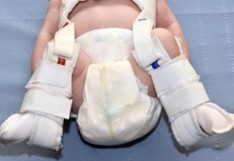
Babies diagnosed with DDH early in life are usually treated with a fabric splint called a Pavlik harness. This secures both of your baby’s hips in a stable position and allows them to develop normally. The harness needs to be worn constantly for several weeks and should not be removed by anyone except a health professional.
We will provide detailed instructions on how to look after your baby while they are wearing a Pavlik harness.
Occasionally, surgery may be needed if the Pavlik harness has not helped.
How is DDH diagnosed?
In order to diagnose DDH, your baby will need to have an ultrasound scan. It is essential for your baby to attend an appointment.
On the day of the appointment, your baby will have an ultrasound scan of the affected hip(s) and an assessment by a member of the medical team.
We will discuss the results of the scan with you and if DDH is diagnosed, the appropriate treatment will be discussed with you. If you are unable to attend your appointment, please contact the Children’s Outpatient Department on 01384 244298.
If you have any questions, or if there is anything you do not understand, please contact the Russells Hall Hospital switchboard number on (01384) 456111 and ask for the relevant department who issued this leaflet.
This leaflet can be made available in large print, audio version and in other languages, please call 0800 073 0510.