
Maternity
Who is this information for?
This information is for you if you are pregnant and have been advised by your doctor that you may be at risk of their baby being born too early (preterm birth). It gives information about two treatments that may help lower that risk:
This information leaflet is about Cervical Cerclage.
You may be offered one of these treatments if:
This leaflet is designed to help you understand your options and make a decision that feels right for you. You can use it to guide discussions with your midwife, obstetrician, or the Rainbow team.
What is a cervical cerclage?
A cervical cerclage is a procedure to place a special stitch in your cervix (neck of the womb) to help keep it closed during your pregnancy. Your obstetrician is concerned that you have a condition called incompetence, where your cervix is weak.
Although an ultrasound scan may suggest there is a problem, unfortunately losing a baby early in a pregnancy can be the only sign that you may have a weak cervix. If you are aware that you have cervical weakness, a cervical cerclage can usually be performed at between 12-24 week of your pregnancy. Your obstetrician will usually remove the stitch around 36 weeks.
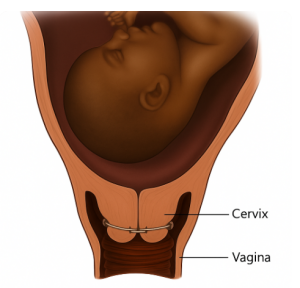
Remember your obstetrician has suggested a cervical cerclage. However, it is your decision whether to go ahead with the procedure or not.
What are the benefits and risks of a cervical cerclage?
When you become pregnant, your cervix should close tightly and block off your uterus (womb) with a plug of mucus. As your baby grows, the pressure on your cervix increases.
If you have a weak cervix, your cervix may open without any pain and cause your membranes to bulge out and rupture (your waters breaking). A weak cervix may cause you to have a late miscarriage (when your pregnancy ends after 12 weeks and before 24 weeks) or to give birth early.
If you have had surgery to your cervix before, or problems in a previous pregnancy that involved surgery such as a miscarriage or termination, your cervix may have become weak. However, sometimes the tissues of your cervix are weak for no apparent reason.
You may need to have a transvaginal ultrasound scan from 12 weeks to check the length of your cervix and to find out if you have ‘funnelling’, where the inside part of your cervix tends to open when pressure is applied to your womb.
Placing a special stitch in your cervix should help to prevent you from losing your baby because of a weak cervix. The procedure is successful in treating a weak cervix in 9 in 10 pregnancies.
However, the procedure itself can cause your membranes to rupture early or you to go into premature labour. You should discuss the benefits and risks carefully with your obstetrician.
Are there any alternatives to a cervical cerclage?
Depending on your medical history, your obstetrician may discuss an alternative treatment called progesterone. This is a hormone which is inserted through your vagina instead of using a cervical stitch. A cervical cerclage can be placed through the abdomen. This is usually used if a vaginal cerclage has not worked in the past.
If these options are not suitable for you, your obstetrician will monitor you closely by performing regular ultrasound scans. If your obstetrician notices a change in your cervix, they will discuss your options with you again.
Please see progesterone information leaflet for more information.
What will happen if I decide not to have cervical cerclage?
Your obstetrician will arrange for you to have regular ultrasound scans. There is a risk you may have a late miscarriage or premature birth.
What does the procedure involve?
The procedure is usually performed under a spinal anaesthetic. Your anaesthetist will discuss the options with you.
A cervical cerclage usually takes 20 to 30 minutes.
Your legs will be put in ‘stirrups’. Your obstetrician will use antiseptic to clean your vagina. They will place instruments in your vagina and use them to place a stitch, using a thick synthetic tape, into and around your cervix.
What complications can happen?
As a team we will also try to reduce the risk of complications. You need to know about them to help you to make an informed decision about the procedure.
Knowing about them will also help to detect and treat any problems early.
Some risks are higher if you are older, obese, a smoker or have other health problems including diabetes, heart disease or lung disease. Some complications can be serious and can even cause death.
Please ask your obstetrician if there is anything you do not understand.
The possible complications of a cervical cerclage are as follows:
How soon will I recover?
In hospital:
After the procedure you will be transferred to the recovery area and then to the ward.
You should be able to go home on the same day. However, your doctor may recommend that you stay a little longer.
It is normal to have a small amount of bleeding for a few days
Returning to normal activities:
Rest for a few days and then gradually return to normal activities. You should be able to return to normal activities, including having sex, after 7 to 10 days. Do not do strenuous exercise.
If you get any pain, bleeding, contractions or think you may be going into labour, contact triage straight away.
Are there situations when a cervical cerclage would not be advised?
Sometimes a cervical stitch is not advised because it may carry risks to you, and it would not improve the outcome for your baby. This may be if:
How and when will the cerclage be taken out?
Your stitch will be taken out at the hospital. This will normally happen at around 36–37 weeks of pregnancy, unless you go into labour before then.
If you are having a planned caesarean, the stitch can be taken out at the time of the operation.
A speculum is inserted into your vagina and the stitch is cut and removed. You will not normally need anaesthetic for removal of the stitch but occasionally you will be advised by your healthcare professional that this is necessary.
It usually takes just a few minutes, and you may experience some discomfort. Most women do not go into labour immediately after their stitch is removed.
If you go into labour with the cervical stitch still in place, you should contact your maternity unit straight away.
It is important to have the stitch removed to prevent damage to your cervix. If your waters break early but you are not in labour, the stitch will usually be removed because of the increased risk of infection. The timing of this will depend on your individual situation.
If you have any questions, or if there is anything you do not understand, please contact the Russells Hall Hospital switchboard number on (01384) 456111 and ask for the relevant department who issued this leaflet.
This leaflet can be made available in large print, audio version and in other languages, please call 0800 073 0510.