Patient Information Leaflet
Introduction
This leaflet is for patients who are having a procedure called a hysteroscopy. It explains what the procedure involves, what it is used for and its risks.
What is a hysteroscopy?
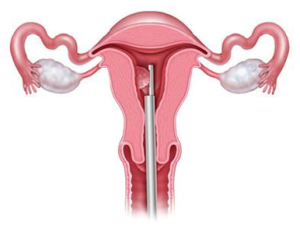
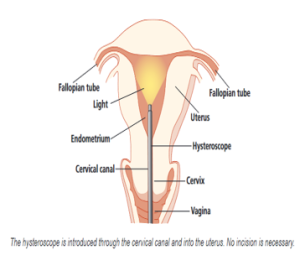
A hysteroscopy is a procedure that involves passing a thin telescope like device called a hysteroscope through the cervix (neck of the womb) to examine inside of your uterus (womb). This allows the healthcare professional performing the procedure to see whether there are any problems inside your uterus which may need further investigation or treatment.
Minor procedures can be performed at the same visit such as:
- Endometrial biopsy: this involves taking a sample from the lining of the uterus. This can either be performed through the hysteroscope or by passing a thin tube through the cervix. You may experience period like pain during this procedure, but the pain should not last long.
- Polyp removal: A polyp is a skin tag that looks like a small grape, sometimes on a stalk. It is a result of overgrowth of the lining of the uterus.
- Small fibroid removal: Fibroids are knots in the muscle of the uterus that are non- cancerous. They can sometimes bulge into the lining of the womb like a polyp.
- Insertion of hormone releasing intrauterine device such as a Mirena coil
- Removal of a coil from the uterus when the treads are not visible.
Why have I been referred for outpatient hysteroscopy?
The purpose of your appointment is to find a cause of your symptoms and plan or undertake treatment if needed. You may have been referred for the following reasons:
- Bleeding after menopause
- Very heavy periods
- Bleeding between periods or after sexual intercourse.
- Irregular bleeding on hormonal treatment
- Removal of a coil when the threads are not visible at the cervix.
- Fertility concerns
- Following a miscarriage
- To investigate something seen inside your uterus on an ultrasound scan such as a polyp or fibroid.
What are the possible risks of a hysteroscopy?
As with all procedures, a hysteroscopy carries some risks and complications. It is important that we tell you about these risks so that you have the information you need to make a decision about the procedure.
- Pain during or after the hysteroscopy is usually mild period like pain. Some may experience severe pain. Pain relief options will be discussed with you at your appointment.
- Feeling or being sick or fainting can affect a small number of women. However, these symptoms usually settle quickly. Please let your healthcare professional if you are feeling unwell during or straight after the procedure.
- Bleeding is usually lighter than a period and settles within a few days. It is recommended to use sanitary towels and not tampons.
- Infection is uncommon (1 in 400 women). It may appear as smelly discharge, fever (temperature over 38°C / 4°F), or severe tummy pain. If you get any of these symptoms, you will need to visit your GP for advice. You may need to have antibiotics to treat it.
- Failed or unsuccessful hysteroscopy can occur if it is not possible to pass the hysteroscope into your uterus. This can occur if the cervix is tightly closed or scarred. Your healthcare professional will discuss alternative options with you.
- Damage to the wall of the uterus (uterine perforation), rarely a small hole is accidentally made in the wall of the uterus. This happens in fewer than 1 in 1000 hysteroscopy procedures but is slightly more common in someone with a polyp or fibroid removed at the same time. You may need to stay in hospital overnight. Usually nothing more needs to be done but you may need a further operation to repair the hole.
How do I prepare for the procedure?
- You can eat and drink as normal. There is no requirement to fast prior to your appointment.
- It is recommended to take pain relief (400 mg of ibuprofen or 1 gram of paracetamol or whatever pain relief you find useful for period pain) at least 1 hour before your appointment.
- Bring a list of medications that you are taking.
- You may wish to bring a friend or family member with you.
- ContraceptionThe procedure must not be performed if there is any chance you are pregnant. To avoid this possibility, it is important to use contraception or avoid sex between your last period and your appointment. You may be offered a urine pregnancy test on arrival at your appointment.
- Bleeding If you will have your period or are bleeding on the day of your appointment, please call 01384 244584 (between 8.30am and 5pm) to discuss this as sometimes the appointment may need to be rearranged.
What will happen at the appointment?
On arrival
You will meet the healthcare professional who will discuss the procedure and ask for your consent. Please take this opportunity to ask any questions you may have. There will be at least two other healthcare professionals in the room, one will be assisting the healthcare professional carrying out the procedure and the other will support you throughout the procedure.
The procedure
- The clinician will attempt to do a vaginoscopy, this is without the use of a vaginal speculum. If a biopsy is needed a speculum will need to be used. This is the same instrument used in a cervical screening (smear) test. This is used so that they can see your cervix clearly. You may be given some local anaesthetic to numb your cervix or offered Penthrox (similar to “gas & air”) if you find the procedure uncomfortable.
- A hysteroscope is passed though the cervix to give a clear view of inside of the uterus. Fluid (saline solution) is used to help see the inner lining of the womb.
- During the hysteroscopy, the healthcare professional will look inside your uterus on a screen, you can also choose to watch the screen. Photographs of findings inside your uterus are taken and kept in your healthcare notes.
- If no problems are found the actual procedure will only take 10-15 minutes. Sometimes a small sample (endometrial biopsy) is taken from the lining of the womb and sent to the laboratory for closer examination.
- If a fibroid or polyp is found it can sometimes be removed by using a Myosure. A Myosure hysteroscopy enables removal of the tissue under vision using the hysteroscope.
- Please scan the QR code below to watch a short video with more information about your procedure
After the procedure
You may experience some cramping pains, similar to period pains, for a few days after the procedure. Pain-relieving drugs such as paracetamol, or ibuprofen (if you can take it) should relieve this (always read the label, do not exceed the recommended dose). If the pain does not go away or gets worse, see your GP.
You may experience some bleeding for a few days. It should not be heavy. Use sanitary pads, not tampons, during this time to help reduce the risk of infection.
If the bleeding becomes heavy (with clots), starts to smell unusual, or you experience severe pain, you should contact your GP as this may mean you have an infection.
What can I expect following a hysteroscopy?
Your healthcare professional will discuss with you the findings and whether further interventions are required. If no problems are found, you may not need follow up appointments.
If a biopsy has been taken, it may be necessary to wait for the results of this before a follow up appointment is made. Biopsy results are usually conveyed to you via a letter, if appropriate. This can take three to four weeks.
Can I find out more?
You can find out more from the following web link:
NHS Choices
https://www.nhs.uk/tests-and-treatments/hysteroscopy/
Royal College of Obstetrics and Gynaecology
https://www.rcog.org.uk/for-the-public/browse-all-patient-information-leaflets/outpatient-hysteroscopy/
Originator: Sharon Turner. Date reviewed: October 2026. Next review due: October 2029. Version: 6. DGH ref: DGH/PIL/01077.
Reviewed: Dr Farah Naz Specialist Obstetrics and Gynaecology and Dr Wesal Yahya Hamed Obstetrics and Gynaecology Specialty Trainee